
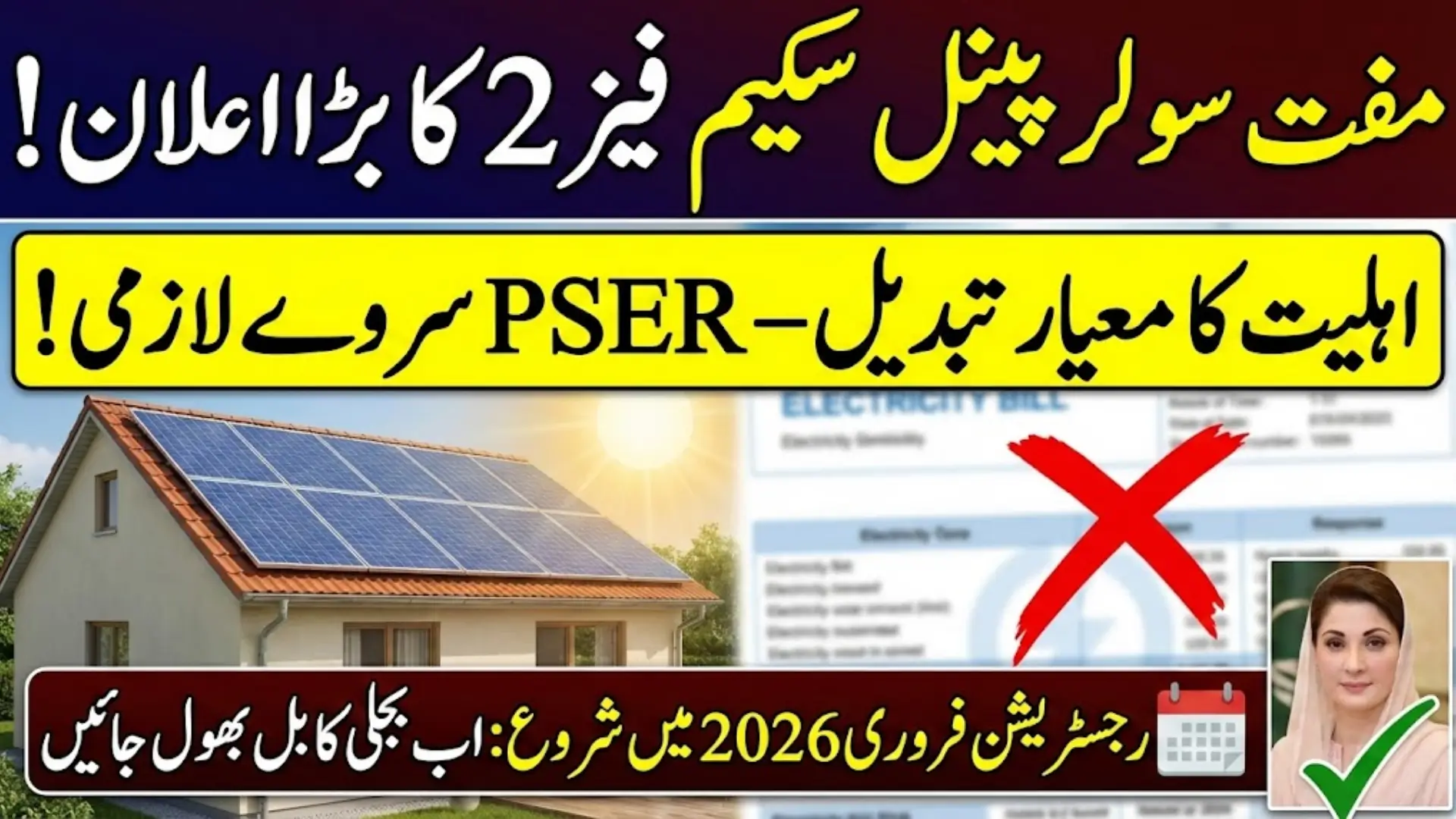
Free Solar Panel Scheme Phase 2 Start In 2026 Get 1-2 kW System Free
Watching your electricity meter spin faster every month while knowing you can’t afford to run fans during summer heat. Choosing between using the AC or feeding your family properly. Paying Rs 8,000 to Rs 12,000 monthly for basic power while inflation eats your income. This reality crushes millions of Punjab households where electricity has transformed from necessity to luxury.
The Free Solar Panel Scheme Phase 2 Start In 2026 changes this equation permanently. Chief Minister Maryam Nawaz’s initiative provides complete 1-2 kW solar systems absolutely free to eligible low-income households consuming under 200-300 units monthly. Not partial discounts. Not installment plans. Complete free solar panels, inverters, batteries, and professional installation delivered to your rooftop. Registration opens late February 2026, targeting 100,000 households through transparent digital balloting managed via the Ebiz Punjab Portal and related government platforms.
Understanding What You Actually Receive Free
Phase 2 doesn’t just give you panels and expect you to figure out installation. You receive a complete turnkey solar system ready to power essential home appliances.
Complete Solar System Components
Solar panels (4-8 panels depending on capacity)
High-efficiency photovoltaic panels converting sunlight to electricity, typically 250-350 watts each.
Solar inverter (1000-2000 watts)
Converts DC power from panels into AC power your home appliances use.
Battery storage system
Stores excess power generated during daytime for nighttime use when panels aren’t producing.
Mounting structure and hardware
Roof-mounting equipment, wiring, safety components, and electrical connections.
Professional installation
Government-certified technicians install entire system following safety standards.
Warranty and after-service
Manufacturer warranties on panels (typically 20-25 years) and service support for technical issues.
This complete package typically costs Rs 200,000 to Rs 300,000 commercially. Phase 2 provides it free to verified eligible households.
February 2026 Registration Timeline
Unlike previous phases with unclear schedules, Phase 2 follows structured timeline coordinated with Ramadan preparation period.
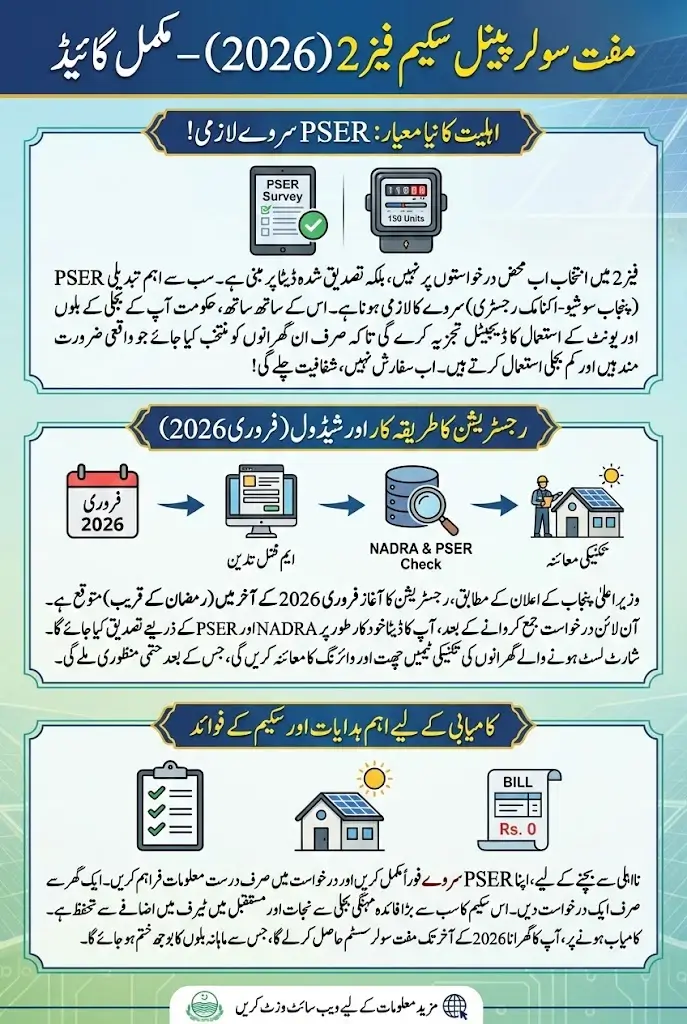
Late February 2026: Registration opens
Online portal cmsolarscheme.punjab.gov.pk activates for applications.
March 2026: Verification process
PSER data cross-checking, electricity consumption verification, NADRA CNIC confirmation.
April-May 2026: Physical inspections
Technical teams visit shortlisted homes assessing roof suitability and electrical compatibility.
June-December 2026: Phased installations
Installations completed before summer 2027 peak usage season.
This timeline ensures systems operate before next summer when electricity demand and costs spike dramatically.
Complete Eligibility Requirements
Phase 2 tightened eligibility based on Phase 1 lessons where some ineligible households received systems while deserving families got excluded.
Permanent Punjab residency with valid CNIC
Your national identity card must show Punjab address and remain unexpired.
Monthly electricity consumption: 0-200 units (some areas allow up to 300 units)
Verified through last 6 months’ electricity bills from LESCO, FESCO, GEPCO, MEPCO, or IESCO.
Sanctioned load up to 2 kW maximum
Your electricity connection must be residential with load not exceeding 2 kilowatts.
Completed PSER (Punjab Socio-Economic Registry) survey
This is mandatory. Without PSER registration showing low-income status, automatic disqualification occurs regardless of other eligibility.
No electricity theft history
Clean record required. Any past incidents of meter tampering, illegal connections, or theft disqualify you permanently.
Single residential meter per address
Households with multiple meters at same location don’t qualify. One legitimate residential meter only.
No defective or malfunctioning meters
Your meter must be functioning properly with accurate readings.
Priority goes to families registered in government welfare programs (BISP, Ehsaas), confirmed low-income households, and rural area residents where load-shedding impacts farming and daily life severely.
Why PSER Survey is Absolutely Mandatory
PSER (Punjab Socio-Economic Registry) forms the backbone of Phase 2 eligibility verification, replacing self-declared income statements that enabled fraud in earlier schemes.
What PSER Actually Does
Records complete household economic data
Family size, income sources, asset ownership, living conditions, and poverty indicators.
Generates PMT (Proxy Means Test) score
Mathematical calculation determining household poverty level based on multiple verified factors.
Connects across government welfare programs
Links to BISP, Ehsaas, Sehat Card, and other assistance ensuring coordinated support.
Prevents duplicate benefits
Identifies households already receiving substantial government support preventing double-dipping.
Without completed PSER survey showing low-income qualification, your application fails automatic verification regardless of electricity consumption levels or other factors.
If you haven’t completed PSER survey, visit nearest Union Council office immediately. Survey teams assess your household, record data digitally, and generate official PSER certificate within 2-3 weeks. Don’t wait until Phase 2 registration opens because survey backlogs delay processing.
Online Application Process Step-by-Step
Registration happens entirely online through official government portal ensuring transparency and preventing agent exploitation.
Visit cmsolarscheme.punjab.gov.pk
Only use this official website. Fake portals steal personal information.
Click registration/application section
New applicants select “Apply Now” or similar clearly marked button.
Enter CNIC number for verification
System cross-checks against NADRA database confirming identity validity.
Provide electricity reference number
Enter 14-digit reference number from your latest electricity bill.
Submit mobile number for OTP
Registered mobile on your CNIC receives one-time password for authentication.
Upload required documents
Scan and attach CNIC (both sides), recent electricity bill, PSER certificate, and residential proof.
Submit application and save tracking ID
After submission, download or screenshot your unique reference number for status checking.
Applications submitted after deadline receive automatic rejection without review. No exceptions or extensions.
Required Documents Checklist
| Document Type | Specific Requirement | Purpose |
|---|---|---|
| CNIC | Original, both sides, not expired | Identity confirmation |
| Electricity Bill | Last 3-6 months, under 200-300 units | Consumption verification |
| PSER Certificate | Valid, showing low-income status | Economic eligibility |
| Proof of Residence | Utility bill, rent agreement, ownership | Address confirmation |
| Passport Photos | Recent, clear, white background | Application record |
Ensure all scans are clear, complete, and legible. Blurry or partial documents trigger automatic rejections.
Transparent Digital Balloting System
Phase 2 uses Punjab Information Technology Board (PITB) computerized lottery ensuring fairness and eliminating human bias.
All eligible applications enter random draw
No manual selection, political influence, or favoritism possible in automated system.
District-wise quota allocation
Prevents urban areas monopolizing while rural districts get ignored. Each area receives proportional share.
Public announcement of results
Winners published on official portal with CNIC-based verification preventing impersonation.
SMS and email notifications
Selected households receive official messages with next-step instructions.
Waitlist system for unfulfilled quotas
If selected households fail inspections or decline, waitlisted applicants move up automatically.
Post-Selection Technical Inspection
Selection in balloting doesn’t guarantee installation. Your home must pass technical feasibility assessment.
Roof structural integrity check
Engineers verify your roof can support panel weight (approximately 15-20 kg per square meter).
Sunlight exposure analysis
Panels need minimum 4-6 hours daily direct sunlight. Heavy shade from trees or nearby buildings can disqualify location.
Electrical wiring assessment
Existing home wiring must safely handle solar system integration. Dangerous or substandard wiring requires upgrades before installation.
Load compatibility verification
Your typical appliance usage must align with 1-2 kW system capacity. Homes running heavy industrial equipment don’t qualify.
Security and access evaluation
Installation team needs safe roof access and secure panel placement preventing theft risks.
Homes failing technical inspection lose selection regardless of balloting success. System gets reallocated to waitlisted households passing inspections.
What 1-2 kW Solar System Can Power
Understanding realistic capacity prevents disappointment after installation.
Appliances 1 kW system handles: 4-6 LED lights throughout home, 2-3 ceiling fans simultaneously, 1 LED TV, mobile phone charging, small refrigerator (during daytime with battery backup at night)
Appliances 2 kW system handles: All 1 kW capacity plus additional fans, water motor (limited hours), washing machine (moderate use), laptop/computer, microwave (short duration)
Appliances solar systems DON’T handle: Large air conditioners (1.5-2 ton), electric geysers, heavy irons, industrial equipment, simultaneous heavy appliances
Realistic expectations prevent misuse and system damage. Solar supplements grid power for essential items, not complete house electrification.
Long-Term Electricity Bill Impact
Free solar dramatically changes household economics beyond installation month.
| Scenario | Monthly Bill Before Solar | Monthly Bill After Solar | Annual Savings |
|---|---|---|---|
| 150 units consumption | Rs 6,000-8,000 | Rs 1,000-2,000 | Rs 60,000-84,000 |
| 200 units consumption | Rs 8,000-10,000 | Rs 2,000-3,000 | Rs 72,000-84,000 |
| 250 units consumption | Rs 10,000-12,000 | Rs 3,000-4,000 | Rs 84,000-96,000 |
These savings compound over 20-25 year panel lifespan, representing Rs 1.5 million to Rs 2 million total household savings.
Common Application Rejection Reasons
Most rejections stem from preventable mistakes, not actual ineligibility.
Electricity consumption exceeds 200-300 unit ceiling
Even one month over limit triggers disqualification. Reduce usage before applying if borderline.
PSER survey not completed or showing higher income
Incomplete surveys or PMT scores above poverty threshold cause automatic rejection.
Multiple applications from same household
Submitting duplicate applications from family members disqualifies entire household permanently.
Expired or mismatched CNIC information
CNIC expired even by one day, or name/address mismatches between CNIC and electricity bill cause rejection.
History of electricity theft or meter tampering
Past violations permanently blacklist households from solar and other welfare schemes.
Providing false information or fake documents
Fraudulent submissions trigger legal action beyond simple rejection.
Frequently Asked Questions
When does Free Solar Panel Scheme Phase 2 registration start?
Registration opens late February 2026, likely coordinating with Ramadan start. Exact date announced on official portal cmsolarscheme.punjab.gov.pk.
What is the maximum electricity consumption to qualify?
Monthly consumption must remain under 200 units (some districts allow up to 300 units). Verified through last 6 months’ bills.
Is PSER survey mandatory for solar panel scheme?
Yes, absolutely mandatory. Without completed PSER showing low-income status, automatic disqualification occurs regardless of other eligibility factors.
How much does the free solar system cost if I bought it commercially?
Complete 1-2 kW system with panels, inverter, batteries, installation, and warranty costs Rs 200,000 to Rs 300,000 in private market.
Can I apply if I live in a rented house?
Technically yes if electricity meter is in your name and landlord provides written permission for roof installation. However, homeowners receive priority.
Final Thoughts
Free Solar Panel Scheme Phase 2 Start In 2026 represents Punjab’s most significant household energy relief initiative, targeting 100,000 families with complete solar systems worth Rs 200,000-300,000 each, absolutely free.
Register when portal opens late February 2026 at cmsolarscheme.punjab.gov.pk. Ensure your PSER survey is completed now, not after registration starts. Verify your monthly electricity consumption stays under 200-300 units. Prepare all required documents in advance.
For families spending Rs 8,000 to Rs 12,000 monthly on electricity, Phase 2 solar installation could save Rs 70,000 to Rs 100,000 annually, transforming household economics permanently. This isn’t temporary bill relief. It’s permanent energy independence lasting 20-25 years minimum.
Don’t let incomplete preparation prevent you from benefiting. Complete PSER survey today, organize your documents, and apply immediately when registration opens. This opportunity could fundamentally change your family’s financial stability for decades.